Photo by 04iraq on Pexels
EV vs Gas Car Cost Comparison: 5-Year Breakdown
A $38,000 EV and a $30,000 gas car look worlds apart at the sticker — but factor in fuel, maintenance, and the $7,500 federal tax credit and the gap closes fast. Here's exactly which buyer comes out ahead, by annual mileage and budget.
Is the $7,500 federal tax credit enough to make an EV actually cheaper than a gas car over five years?
Most buyers assume EVs cost more — period. They're wrong. But the full picture is messier than EV advocates admit and more favorable to EVs than gas-car loyalists will tell you. After running the actual numbers on two comparable 2026 models, here's what the math shows.
The Head-to-Head: By the Numbers
Let's set the stage with two real vehicles in the $30K–$40K range — the kind of purchase most serious car buyers are actually weighing.
The matchup:
- EV: 2026 Chevrolet Equinox EV (base ~$35,000)
- Gas: 2026 Toyota RAV4 (base ~$32,000)
These aren't cherry-picked outliers. They're among the bestselling EV and gas SUVs in their price bracket. Here's how they compare:
| Category | Chevy Equinox EV | Toyota RAV4 | Winner |
|---|---|---|---|
| Sticker price | $35,000 | $32,000 | Gas |
| After federal tax credit | $27,500 | $32,000 | EV |
| 5-year fuel/charging cost | ~$3,430 | ~$9,375 | EV |
| 5-year maintenance | ~$2,500 | ~$5,000 | EV |
| 5-year insurance | ~$9,500 | ~$8,500 | Gas |
| 5-Year Total Cost | ~$47,770 | ~$60,435 | EV by ~$12,700 |
The EV wins on total cost — decisively. But that $12,700 advantage has real conditions attached, and I'll walk through each line below.
Deep Dive: What an EV Actually Costs Over 5 Years
 Photo by RDNE Stock project on Pexels
The Purchase Price After Credits
The Equinox EV's $35,000 sticker shrinks to $27,500 if you qualify for the full $7,500 federal EV tax credit. Starting in 2024, dealers can apply it directly at point of sale, which means it reduces your loan principal immediately — not as a check you wait months to receive.
There's a catch. The credit phases out above $80,000 MAGI for single filers, $160,000 for joint filers. Above those thresholds, the EV's biggest financial advantage disappears. Check eligibility before you build your entire budget around it.
If you're financing, compare rates before signing anything at the dealership. NerdWallet Auto Loans shows current offers from multiple lenders side by side — auto loan rates in 2026 range from under 5% for excellent credit to above 9% for subprime, and a single percentage point difference on a $27,500 loan costs or saves roughly $750 over a 60-month term.
Charging Costs: The Actual Calculation
Here's the math most EV articles skip. The Equinox EV gets roughly 3.5 miles per kWh. At 15,000 miles per year:
- 15,000 miles ÷ 3.5 mi/kWh = 4,286 kWh/year
- At the U.S. average residential rate of $0.16/kWh → $686/year
- Over 5 years: $3,430 total
Compare that to $1,875/year for a gas car at the same mileage. The gap is real. The catch: this assumes home charging. If you rely heavily on DC fast chargers — which run $0.30–$0.50/kWh — your charging cost nearly triples, and you lose roughly half the energy-cost advantage. If you own a home and can install a Level 2 outlet for $500–$1,000, you'll recoup that cost in under 18 months.
Public-only charging doesn't make an EV unviable. It just makes the math closer.
EV Maintenance: Simpler Than You Think
No oil changes. No transmission fluid. No spark plugs. No timing belt. Regenerative braking means brake pads last dramatically longer than on a gas vehicle. Consumer Reports data consistently shows EV owners spend roughly 40–50% less on maintenance than comparable gas car owners.
The real-world estimate: ~$500/year for a well-maintained EV versus ~$1,000/year for a comparable gas SUV. That's a $2,500 gap over five years — and it tends to widen as gas vehicles age past the 3-year mark and start hitting more expensive service intervals.
EV Insurance: The Area Where Gas Cars Win
This one catches EV buyers off guard. EVs cost more to insure — typically 10–20% higher premiums — because repair costs are higher (battery modules, specialized technicians), and replacement value is higher even after depreciation. Budget roughly $1,900/year for the Equinox EV versus $1,700/year for the RAV4.
That $200/year gap adds up to $1,000 over five years. Before you buy, use Credit Karma Car Insurance to pull quotes from multiple carriers. Rates for the same EV model can vary by $400–$600 per year between insurers, and some carriers have become significantly more competitive on EVs as the market has grown. Don't accept the first quote.
Deep Dive: What a Gas Car Actually Costs Over 5 Years
The Sticker Price Advantage — And Why It Evaporates
The RAV4's $32,000 sticker looks better than the Equinox's $35,000 at first glance. After the EV tax credit, you're comparing $32,000 to $27,500. The "cheaper" gas car is suddenly $4,500 more expensive out of pocket.
Financing $32,000 at 6.5% for 60 months costs roughly $5,560 in interest. The same rate on $27,500 costs about $4,840. Lower principal means less total interest paid — the EV wins this round too, entirely because of the tax credit compressing its financed amount.
If you're shopping used and want to keep upfront cost low, Carvana lists used EVs alongside gas vehicles and lets you filter by monthly payment — worth checking before defaulting to new. A 2023 Chevy Bolt EV in clean condition often shows up in the $22,000–$26,000 range, and used EVs under $25,000 may qualify for a separate $4,000 federal used EV credit (income limit: $75K single, $150K joint).
Fuel Costs: Where Gas Cars Bleed Money Over Time
At the RAV4's 28 MPG combined, 15,000 miles per year burns through 536 gallons. At $3.50/gallon, that's $1,875/year — $9,375 over five years.
Gas prices are the wildcard that most five-year cost estimates under-discuss. If prices climb to $4.50/gallon (which happened in 2022 and could happen again), that five-year fuel bill jumps to $12,054. Drop to $2.75 and it falls to $7,370. The EV's residential electricity cost, by contrast, moves slowly — utilities raise rates in small increments, not dollar-per-gallon swings. Over a five-year horizon, the EV's energy cost is structurally more predictable.
Gas Car Maintenance: The Costs That Creep Up
Four oil changes a year average $75 each: $300. Add air filters, spark plugs at mileage intervals, transmission service, and the inevitable unscheduled repairs. A realistic $1,000/year is conservative — Consumer Reports puts average annual maintenance for non-luxury gas vehicles closer to $1,200–$1,400/year as the vehicle ages past year three. Timing belts and water pumps don't care about your budget.
Over five years: $5,000–$7,000 in gas car maintenance for a typical buyer who doesn't defer anything. The EV buyer pays roughly half that, and doesn't sweat the 60,000-mile service appointment.
What Changes Based on How Much You Drive
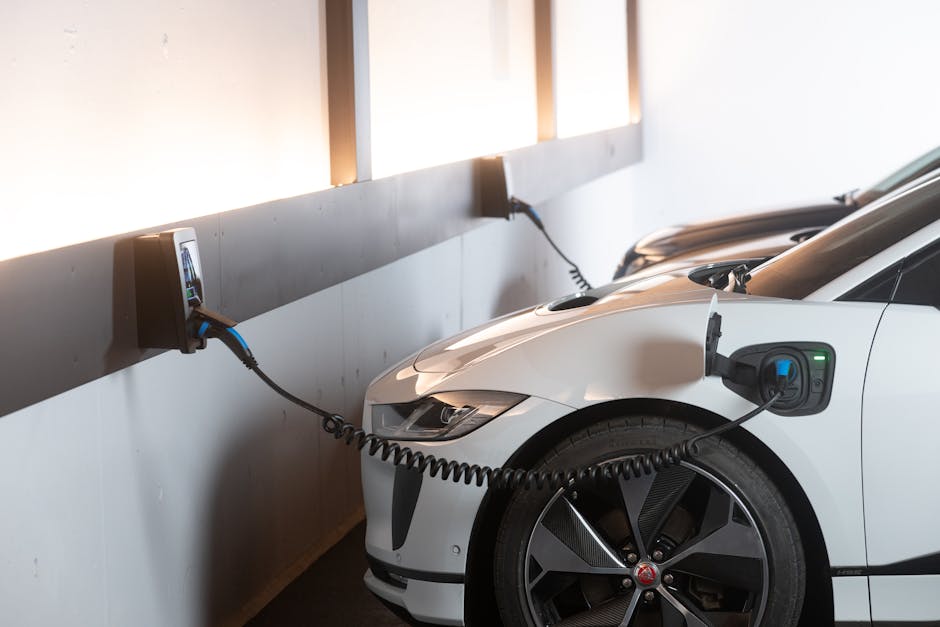 Photo by smart-me AG on Pexels
The $12,700 EV advantage assumes 15,000 miles annually. That number shifts significantly depending on your driving patterns:
| Annual Miles | EV 5-Year Energy Cost | Gas 5-Year Fuel Cost | EV Fuel Advantage |
|---|---|---|---|
| 10,000 mi/year | $2,286 | $6,250 | $3,964 |
| 15,000 mi/year | $3,430 | $9,375 | $5,945 |
| 20,000 mi/year | $4,572 | $12,500 | $7,928 |
| 25,000 mi/year | $5,715 | $15,625 | $9,910 |
EV: $0.16/kWh, 3.5 mi/kWh. Gas: $3.50/gallon, 28 MPG combined.
High-mileage drivers get dramatically more from an EV. If you're driving 20,000+ miles per year — long commutes, rideshare, frequent road travel on familiar routes — the fuel savings alone nearly justify the switch. Under 10,000 miles annually, the savings shrink, the break-even point stretches past five years, and the case for an EV gets weaker.
Who Should Buy an EV — and Who Shouldn't
Buy an EV if:
- You qualify for the $7,500 federal tax credit (MAGI under $80K single / $160K joint)
- You own your home or can install a Level 2 charger where you park overnight
- You drive 12,000+ miles annually — the more you drive, the faster you recoup the premium
- You're planning to keep the vehicle at least 4–5 years, which is roughly the break-even point where lower running costs overcome any remaining price gap
- You have solid credit and can lock in a competitive financing rate through NerdWallet Auto Loans or a local credit union
Stick with a gas car if:
- You live in an apartment without reliable charging access and don't have convenient nearby public infrastructure
- You regularly take long road trips and find charge-stop planning genuinely inconvenient — charging anxiety is a real friction cost, even as ranges have improved past 250 miles
- Your income is above the federal credit threshold — without the $7,500, the upfront gap narrows significantly
- You're buying a used EV pre-2023 without clear credit eligibility, or the vehicle you want isn't on the approved list
- Monthly cash flow matters more to you right now than five-year total cost — the gas car's lower financed amount means a lower payment, even if the long-run math favors EV
The Myth vs. The Math
 Photo by Plastic Lines on Pexels
Here's what most buyers get wrong. They compare sticker prices and call it done. "The EV costs more." End of analysis.
That's wrong.
Over five years, the buyer who chooses the $35,000 Equinox EV — with the credit applied at signing — over the $32,000 RAV4 comes out roughly $12,700 ahead, assuming average driving habits, home charging, and standard insurance rates. That figure isn't speculative. It breaks down to: $5,945 in fuel savings, $2,500 in maintenance savings, and $4,500 less in financed principal. Minus the $1,000 insurance gap that favors the gas car. The arithmetic holds.
The gas car buyer isn't irrational to think about upfront cost. They're just answering the wrong question. The question isn't which car costs less to buy. It's which car costs less to own.
The Verdict
If you qualify for the federal tax credit and can charge at home: the EV wins, and it's not particularly close. The five-year savings are real, calculable, and large enough that a gas car in the same price bracket can't close the gap on sticker price alone.
If you don't qualify for the credit and depend entirely on public fast charging: buy the gas car. Public charging rates erode the fuel savings and the largest structural advantage EVs hold — predictable, cheap energy — disappears when you're paying $0.40/kWh at a highway station.
For everyone in between: run your own numbers. The four variables that actually move the outcome are annual mileage, home charging availability, federal credit eligibility, and your financing rate. Change any one of them, and the five-year total can shift by thousands of dollars. The table above gives you the inputs. Use it.